
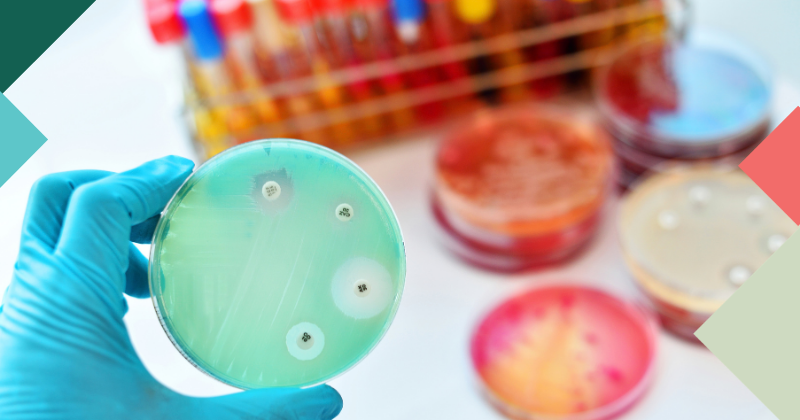
About antimicrobial resistance and the Fleming Fund
Antimicrobial resistance (AMR) is a major global health threat, making infections harder to treat and putting decades of progress in public health at risk. When the Fleming Fund was established in 2015, an influential UK-commissioned review had warned that, without action, drug-resistant infections could cause 10 million deaths a year by 2050 and result in up to US$100 trillion in cumulative global economic losses.
The Fleming Fund was established by the UK Government’s Department of Health and Social Care in response to this growing threat. Across its two phases, it represented a £475 million investment in tackling AMR globally, helping low- and middle-income countries strengthen the laboratories, surveillance systems and workforce needed to generate, share and use reliable data on drug resistance.
Our role
Phase I: building the foundations
During Phase I, we evaluated the Fund’s portfolio of country and regional grants, global projects and fellowship schemes. These investments focused on building stronger AMR surveillance systems in low- and middle-income countries, including laboratory infrastructure, surveillance systems, workforce capacity and national and regional networks.
Our evaluation evolved alongside the programme. Initially, it had a strong formative focus, generating real-time evidence and learning to strengthen implementation. We also provided adaptive management support to Mott MacDonald, the Fund’s managing agent, helping turn emerging evidence into programme improvements. From 2021, our work placed greater emphasis on assessing results and understanding the Fund’s contribution to longer-term outcomes and impact.
Phase II: strengthening sustainability and data use
Evidence generated through the Phase I evaluation helped inform the design of Phase II. While the Fund continued to invest in surveillance systems and workforce capacity, Phase II placed greater emphasis on sustaining these gains and ensuring that better-quality AMR data was analysed, shared and used to inform policy, clinical practice and investment decisions.
Itad was recommissioned as the Fund’s independent evaluation partner for Phase II. Working closely with the Department of Health and Social Care (DHSC) (the Fund Manager), our utilisation-focused evaluation examined the effectiveness, sustainability and value of the Fund’s investments, while generating timely evidence to support programme adaptation and future decision-making.
Across both phases, our role went beyond assessing results. Through country studies, portfolio analysis, evidence synthesis, learning products and reflection sessions, we helped ensure evidence was available when key decisions were being made, while maintaining the independence of the evaluation.
Outcomes and impact
Our long-term evaluation has helped shape how the Fleming Fund evolved and provided evidence of the difference its investments have made. Following Phase I, DHSC accepted the full range of strategic, design and implementation findings from Itad’s evaluation and confirmed that lessons were being incorporated into the design of Phase II.
Building stronger AMR surveillance systems
Our evaluation found important progress in building the foundations for AMR surveillance. Across the Fund’s focus countries, investments strengthened laboratory capacity and the workforce needed to generate reliable AMR data. Early evaluation evidence showed progress across all countries assessed, with 10 out of 20 countries reporting increases of 20% or more in core human-health laboratory functions between 2018 and 2020.
More recent analysis by Itad provides further evidence of the Fund’s impact. Using World Health Organization country data from 2019 to 2024, our evaluation team compared 22 Fleming Fund-supported countries with similar aid-eligible countries and found evidence that the Fund had accelerated improvements in key aspects of AMR surveillance governance, including areas relating to surveillance and regulatory systems.
From generating data to using it
One of the most important shifts influenced by our evaluation was a stronger focus on turning AMR data into action.
Our Phase I evaluation found that, while the Fund was making progress in strengthening surveillance systems and generating data, more was needed to ensure that this evidence influenced policy, regulation and behaviour. We identified opportunities for greater data use and recommended a stronger focus on this in the next phase.
We subsequently supported DHSC and partners through further analysis, input into the programme’s theory of change and business case, and strategic learning. Data use became a major strategic focus of Phase II, alongside sustaining the surveillance capacity built during Phase I.
The difference can be seen at country level. In Malawi, Nepal and Timor-Leste, Fleming Fund-supported surveillance data has contributed to changes in treatment guidance, policy and clinical decision-making, demonstrating the progression from building surveillance systems to putting the resulting evidence to practical use.
Bringing gender and equity into the AMR response
Our evaluation also helped put gender and equity more firmly on the AMR agenda. Evidence and learning from the evaluation contributed to gender and equity becoming an underpinning principle of Phase II. Our work included research into the intersections between gender and AMR, alongside reflection and learning with DHSC and partners.
This work reached beyond the Fleming Fund, contributing to wider international discussion about the implications of gender inequality for AMR, including engagement with experts from the World Health Organization and other global AMR organisations.
Evidence that influenced investment and strategy
The value of a long-term evaluation partnership was that evidence could inform decisions while the programme was still evolving, rather than simply assessing its performance afterwards. Findings from our evaluation were deliberately timed to feed into the development of the second-phase business case, and Itad was subsequently recommissioned as the Fund’s independent evaluation partner for Phase II.
Over ten years, we combined independent scrutiny with evidence that could be acted on, helping DHSC understand what was working, where changes were needed and how to strengthen the effectiveness, sustainability and value of one of the world’s largest investments in AMR surveillance.
For more detail on the impact of our work with the Fleming Fund, see our article ‘Ten years of evidence and learning: strengthening the global response to antimicrobial resistance’.
If you are looking to strengthen the evidence, learning and impact of a complex global health programme, get in touch with our team to discuss how we can help.
Outputs
Fleming Fund Summative Evaluation, July 2026
Fleming Fund Summative Evaluation, July 2026 - Annexes
Strengthening AMR surveillance: Stories of national progress in Africa and Asia
Learning brief: Designing sustainable surveillance systems, July 2026
Learning brief: Getting the most from a fellowship scheme, June 2026
Learning brief: Making antimicrobial resistance surveillance work politically, July 2026
Learning brief: Making the economic case - the value of investing in AMR surveillance, August 2026
The value of a long-term investment: poster presented at UK Evaluation Society Conference 2026
